
Polling data from the Lower Mainland shows a plant-forward future is on the horizon

Polling data from the Lower Mainland shows a plant-forward future is on the horizon

For friends sit around a coffee table eating vegan food.

VANCOUVER, April 18, 2023 – Younger generations in B.C.’s Lower Mainland are increasingly shifting their diets toward plant-based foods, new polling data reveals.

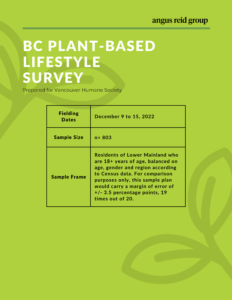
The research poll, commissioned by the Vancouver Humane Society (VHS), examines the dietary preferences and opinions around plant-based eating of Lower Mainland residents. The study was conducted among a representative sample of 803 Lower Mainland residents aged 18+ who are members of the Angus Reid Forum.

Responses reveal a trend away from meat and animal products with each passing generation: vegans and vegetarians comprised 10% of respondents aged 18-34, 9% of respondents aged 35-54, and 6% of respondents aged 55+.

A similar trend can be found when looking at respondents’ reduction of animal-based products. 69% of respondents aged 18-34 had reduced their animal product consumption, compared to 66% of respondents aged 35-54 and 60% of respondents aged 55+.

In addition to vegans and vegetarians, more respondents in the youngest generation identified their diet as “flexitarian” – primarily eating plant-based foods with occasional consumption of animal-based products. 7% of respondents aged 18-34, and 5% of both other age groups surveyed identified as flexitarian.

@vancouverhumane See what people had to say about plant-based eating at PlantUniversity.ca. #PlantBasedFood #Vegan #PlantBased #VeganForTheAnimals ♬ original sound – Vancouver Humane Society

“The increasing availability of plant-based foods and the growing popularity of plant-based diets are mutually reinforcing,” said VHS Communications Director Chantelle Archambault. “Public demand for tasty animal-free options is driving a huge shift in the industry, which in turn makes it easier than ever for more people to put plant-forward meals on their plates.”

Interestingly, motivations for shifting toward a plant-based diet varied by generation. Respondents aged 18-34 identified both economic reasons and environmental concerns as the top factors influencing their decision to consume fewer animal products, while other age demographics were most motivated by personal health.

When considering how and what to eat overall, every age group was most motivated by taste. Archambault says this is also a hopeful sign for the future.

“As the food industry continues to develop innovative tastes and textures for plant-based products, we’re sure to see a wider shift toward a society that eats more sustainably.”

For those looking to add more plants into their diets, the VHS offers free resources and recipes on their Plant University website.

– ends –  

SOURCE Vancouver Humane Society 

For more information, contact Chantelle Archambault: 604-416-2903, chantelle@vancouverhumanesociety.bc.ca

Related links: 

https://plantuniversity.ca/individual/plant-based-poll/

https://docs.google.com/spreadsheets/d/1Qudl4TuKmu7D0Wb2yaPWQF3ChSBJSPTD/edit?usp=sharing&ouid=117203468459354511033&rtpof=true&sd=true

Nearly 3 in 4 British Columbians believe menus with plant-based options are “more inclusive”: research

Nearly 3 in 4 British Columbians believe menus with plant-based options are “more inclusive”: research

VANCOUVER, April 13, 2023 – The majority of British Columbians in the Lower Mainland have positive feelings about plant-based menu options, new polling data reveals. 

The research poll, commissioned by the Vancouver Humane Society (VHS) among a representative sample of Lower Mainland residents from the Angus Reid Forum, asked participants about their dietary preferences and attitudes around plant-based eating.  

73% of respondents agreed that “Food services that offer a greater variety of plant-based options are more inclusive to all”. This sentiment was shared by a majority of people regardless of their own dietary preferences; 95% of vegans or vegetarians and 71% of people following other diets agreed with the statement. 

The poll results demonstrate that the demand for plant-based options is growing, with 65% of respondents having reduced their consumption of animal products.  

Differences between age demographics indicate a growing shift toward plant-based foods over each generation – 69% of respondents aged 18-34 had reduced their animal product consumption, compared to 66% of respondents aged 35-54 and 60% of respondents aged 55+. 

“A growing number of consumers are reducing or eliminating animal-based products, with more people turning to plant-based options when they are available,” said VHS Communications Director Chantelle Archambault.  

Businesses and organizations are already moving to meet the growing demand for plant-forward foods. Many institutions that now offer plant-based menu items, such as Panago Pizza and the University of British Columbia (UBC), cite sustainability commitments as one motivation for the shift.  

“There are so many great reasons to shift towards a more plant-based diet but for us at UBC Food Services we have done this to support the health of our students and the planet,” said David Speight, Executive Chef and Culinary Director of UBC Food Services. “We know that plant-based diets can provide excellent health benefits for our students and they reduce the negative environmental impacts on our planet compared to more animal protein centric diets.” 

Other local businesses and institutions are stepping up to meet consumer demand as well. Last year, the City of Vancouver committed to exploring a 20% reduction in animal-based products in favour of plant-based foods in their municipal food purchasing, such as through catering and city-owned concessions.  

The new polling data suggests that this growing movement toward accessible, affordable, and tasty plant-based options could prompt a greater dietary shift in the future. 65% of respondents identified that they “would eat more plant-based meals if there were more tasty options available when going out to eat”. 

Speight added, “We have shifted a large percentage of our menu offerings to plant-based and our students are still asking for more. It shows a real hunger for great tasting plant-based offerings.” 

@vancouverhumane Visit PlantUniversity.ca for more information! #PlantBased #BCBusiness #Vegan #PlantBasedFood ♬ original sound – Vancouver Humane Society

“With the public increasingly interested in plant-forward food items and calling for corporate responsibility, we’re eager to see more businesses and organizations introduce plant-based options in the coming years to avoid being left behind,” said Archambault. 

This shift has the important added benefit of reducing the number of animals suffering for human food production.  

The VHS is offering free support to B.C.-based institutions, such as restaurants, long-term care homes, and schools, that are interesting in introducing more plant-based menu items. 

– ends –  

SOURCE Vancouver Humane Society 

For more information, contact Chantelle Archambault: 604-416-2903, chantelle@vancouverhumanesociety.bc.ca

Related links: 
https://plantuniversity.ca/individual/plant-based-poll/

https://docs.google.com/spreadsheets/d/1Qudl4TuKmu7D0Wb2yaPWQF3ChSBJSPTD/edit?usp=sharing&ouid=117203468459354511033&rtpof=true&sd=true

https://plantuniversity.ca/blog-post/the-university-of-british-columbia-lessons-in-creating-a-plant-forward-campus/

https://vancouverhumanesociety.bc.ca/posts/municipal-plant-based-purchasing/

Plant-based popularity seems ever-growing

Plant-based popularity seems ever-growing

Plant-based eating has moved into the mainstream in recent years, as demonstrated by a 2018 national survey conducted by Dalhousie University which found British Columbia is leading the dietary revolution. The survey found that nearly 40 per cent of British Columbians 35 and under say they follow a vegan or vegetarian diet.

In North America, a growing number of schools, hospitals, food service providers, businesses and municipalities are recognizing and acting on the collective impact of our food choices, and as a result are embracing the plant-based movement.

At least 16 U.S. cities and counties have included meat-reduction efforts in their climate change mitigation strategies. For example, Santa Monica, California’s climate action plan commits the municipality to reducing meat and dairy purchases by 15% and Portland, Oregon’s climate action plan commits to increasing institutional purchases of healthy, climate-friendly food at public meetings, events, and in government facilities. 

Also in the U.S., Chartwells and Morrison Health Care committed to shifting 20% of menu offerings to plant-based by 2020; the University of Guelph in Ontario is working to replace 20% of meat protein with plant-based proteins; and Western University in Ontario is aiming for 55% of menu options to be based on plant proteins.

Metro Vancouver has seen amazing progress in recent months. In November 2021, citing a report from the Vancouver Humane Society, the City of Vancouver unanimously passed a motion to shift 20% of animal-based purchasing to plant-based. The District of North Vancouver passed another plant-forward motion in March citing the same report.

Amaga Food, a North Vancouver food service provider for several secondary schools, has also committed to transitioning 20% of menu offerings to plant-based. To date, 16 secondary and post-secondary schools throughout Metro Vancouver have also worked to increase their plant-based offerings through initiatives like Meatless Monday.

Share the plant-based movement!

Find tools and tips to advocate for more plant-based options in your area here.

More posts like this